A Fused Quartz Glass Tube is more than a transparent container. It is a high-purity silica component designed for heat, light, and demanding chemical environments. In semiconductor laboratories, it holds wafers inside furnaces that operate at intense temperatures. In analytical equipment, it guides gases, protects sensors, and supports controlled reactions. Some models also serve in ultraviolet lamps, optical systems, and research reactors.
Glass scientist James E. Shelby has emphasized, “The properties of glass are controlled by its composition and thermal history.” This principle explains why fused quartz performs differently from ordinary glass. Its very low thermal expansion helps it resist sudden temperature changes. Its broad optical transmission supports ultraviolet and visible-light applications. Its clean surface also reduces contamination during sensitive processing.
Still, the material is not invincible. A Fused Quartz Glass Tube can devitrify after prolonged exposure to extreme heat. Alkali contamination, mechanical impact, and unsuitable cleaning can shorten its service life. Dimensions matter too. Wall thickness, bore size, surface finish, and end design influence temperature uniformity and gas flow.
The right tube depends on the application.
A laboratory furnace may need a thick-walled tube with carefully finished ends. An optical device may require exceptional clarity instead. This is where selection becomes less simple than product descriptions suggest. Engineers must compare purity, operating temperature, pressure, chemical contact, and maintenance conditions. Small details often decide whether a tube performs reliably or fails earlier than expected.
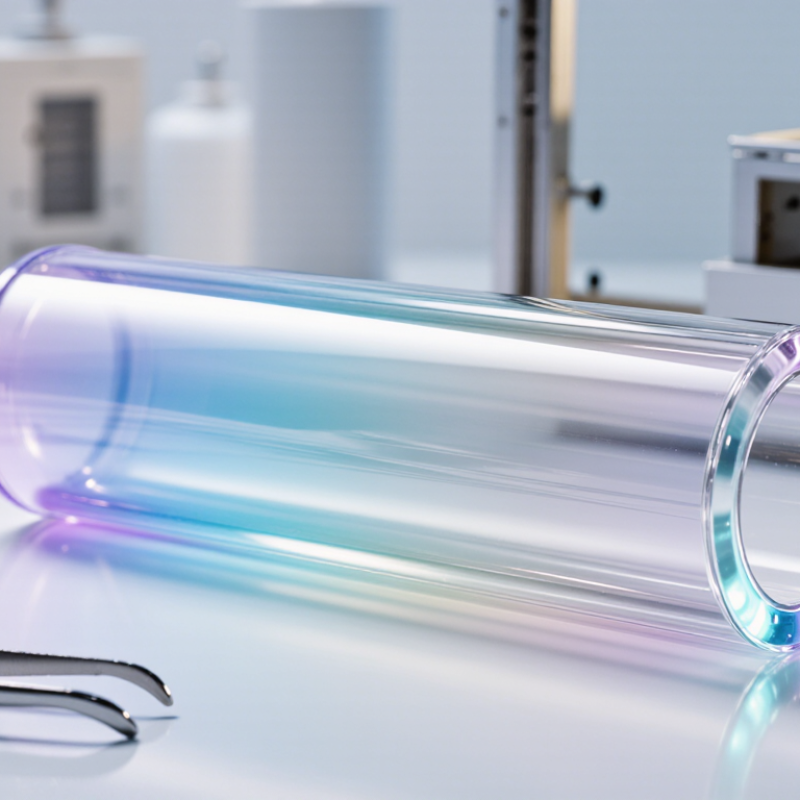
What Is a Fused Quartz Glass Tube Used For?
Definition and Key Properties of Fused Quartz Glass Tubes
A fused quartz glass tube is an amorphous silica component made by melting high-purity silicon dioxide. Unlike ordinary glass, it contains almost no crystalline structure. This gives the tube excellent thermal stability, optical clarity, and chemical resistance. NIST technical data places fused silica’s thermal expansion near 0.55 × 10⁻⁶ K⁻¹ at room temperature. That is extremely low. The material also remains usable at very high temperatures, with a softening point near 1,700°C.
These properties explain its use in laboratory furnaces, semiconductor processing, ultraviolet equipment, and chemical reaction systems. A clear tube can hold a hot sample while allowing visual inspection. It can also transmit ultraviolet radiation, depending on purity, wall thickness, and surface condition. The U.S. Geological Survey’s Mineral Commodity Summaries 2024 reports global industrial silica production at hundreds of millions of metric tons annually. That figure reflects silica’s broad industrial importance, although it does not represent fused quartz tube production alone. This distinction matters.
Tips: Check the required wavelength range before ordering. Some tubes transmit visible light well but absorb deeper ultraviolet energy. Confirm the operating temperature, pressure, tube diameter, wall thickness, and thermal cycling rate. A common mistake is assuming “high purity” always means the same performance. It does not. Small impurities can affect contamination control, optical transmission, or service life. In practice, uneven heating remains a frequent cause of failure, even when the tube material is correctly selected.
Fused quartz glass tubes begin with high-purity silica, not ordinary window glass. The raw material is cleaned, dried, and screened before melting. The U.S. Geological Survey reported about 96 million metric tons of industrial sand and gravel produced in the United States during 2023. Only a carefully refined fraction suits demanding quartz applications.
The silica powder enters an electric furnace or flame-fusion system. Temperatures above 1,700°C remove grain boundaries and create a clear, continuous structure. Operators then form the hot glass over a mandrel, or draw it through precision tooling. Diameter, wall thickness, and roundness must remain stable. Small deviations matter.
After forming, controlled annealing reduces internal stress. Cutting, grinding, and fire-polishing prepare the ends. Inspectors check bubbles, inclusions, surface damage, and optical transmission. Some tubes receive cleaning or dimensional testing for semiconductor, laboratory, ultraviolet, and photovoltaic equipment. The International Energy Agency’s Renewables 2024 report expects nearly 5,500 gigawatts of renewable capacity additions from 2024 to 2030, with solar power providing the largest share. This expansion increases demand for reliable quartz components used around high-temperature processing zones.
The hardest step is not melting. It is consistency.
Even a clean-looking tube may contain hidden stress or excessive hydroxyl content. I have seen specifications treated as absolute, although heating cycles can change performance. That assumption deserves review. Real service conditions should guide the final inspection plan.
A fused quartz glass tube is used where heat, light, and chemical stability matter. It withstands temperatures near 1,000°C in continuous service, depending on grade and design. Its very low thermal expansion reduces cracking during rapid heating and cooling. This makes it useful for furnace liners, heating elements, reaction vessels, and protective sleeves for sensors.
Industrial users commonly install quartz tubes in semiconductor diffusion furnaces and solar-cell processing equipment. The International Energy Agency’s Renewables 2024 report recorded nearly 420 GW of new solar photovoltaic capacity in 2023. That expansion increases demand for controlled, high-temperature process hardware. In laboratories, quartz tubes support atmospheric testing, gas reactions, sample combustion, and ultraviolet spectroscopy. They transmit ultraviolet light better than ordinary glass. They also resist many acids, although not hydrofluoric acid. That limitation is easy to overlook. The fit is rarely perfect.
Tips: Confirm the working temperature, wall thickness, tube diameter, and gas compatibility before ordering. According to ASTM E438, laboratory glassware selection should consider thermal shock resistance and chemical durability. Keep both ends free from uneven mechanical pressure. A scratched tube can fail sooner than expected. Inspect it under bright light, especially after repeated furnace cycles. I would also document cleaning chemicals and heating rates; small process details often explain unexpected fractures.
| Application Area | Typical Use | Why Fused Quartz Is Suitable | Typical Operating Conditions | Important Considerations |
|---|---|---|---|---|
| High-Temperature Furnaces | Protective tubes for thermocouples, heating elements, and sample chambers. | High softening temperature, low thermal expansion, and strong resistance to thermal shock. | Often used from several hundred degrees Celsius to approximately 1,000–1,100 °C, depending on design and atmosphere. | Avoid sudden mechanical impact and contamination from alkaline or metallic materials at high temperature. |
| Laboratory Sample Processing | Reaction tubes, combustion tubes, digestion vessels, and sample holders. | Chemically stable against many acids, water, and solvents; transparent for visual observation. | Commonly selected for controlled heating, drying, calcination, and gas-flow experiments. | Compatibility should be checked with concentrated alkalis, hydrofluoric acid, and hot phosphoric acid. |
| Ultraviolet Lighting and UV Systems | Sleeves, lamp envelopes, and protective windows for ultraviolet light sources. | High-purity fused quartz transmits ultraviolet wavelengths more effectively than ordinary soda-lime glass. | Used in germicidal, analytical, photochemical, and semiconductor-related UV equipment. | Transmission depends on material grade, wall thickness, surface condition, and wavelength. |
| Gas and Vacuum Systems | Reaction chambers, gas-delivery sections, viewports, and laboratory vacuum components. | Low gas permeability, low outgassing after proper cleaning, and resistance to thermal cycling. | Used under reduced pressure or controlled atmospheres such as nitrogen, argon, oxygen, or process gases. | Seals, fittings, wall thickness, and pressure differentials must be engineered for the intended vacuum level. |
| Semiconductor and Solar Processing | Process tubes, wafer supports, diffusion components, and high-purity furnace parts. | High purity, excellent thermal stability, and low contamination compared with many alternative materials. | Typically used in controlled high-temperature environments with carefully managed gas chemistry. | Particle control, cleaning procedures, dimensional tolerance, and surface quality are critical. |
| Spectroscopy and Optical Analysis | Sample cells, optical paths, cuvettes, and protective tubes for analytical instruments. | Broad optical transmission, low fluorescence in suitable grades, and good dimensional stability. | Selected for ultraviolet, visible, and near-infrared measurements according to the required grade. | Optical clarity can be affected by impurities, scratches, deposits, and improper cleaning. |
| Chemical and Pharmaceutical Equipment | Fluid-transfer sections, sight tubes, laboratory reactors, and sampling assemblies. | Nonporous surface, good corrosion resistance, and easy visual inspection of fluids or reactions. | Used for clean process handling, heated liquids, and controlled laboratory reactions. | Mechanical design must account for brittleness, pressure, thermal gradients, and connection methods. |
| Water Treatment and Disinfection | Protective sleeves and chambers around ultraviolet lamps used for water or air treatment. | Efficient UV transmission and resistance to repeated exposure to water and moderate process temperatures. | Common in low-pressure UV disinfection equipment and other controlled-flow systems. | Periodic cleaning is needed because mineral scale or deposits can reduce UV output. |
| Heating and Temperature Measurement | Insulating sleeves, radiant-heating tubes, and protective housings for temperature sensors. | Electrical insulation, thermal stability, and low expansion help maintain reliable measurements. | Suitable for laboratory and industrial heating systems when the temperature and atmosphere are properly controlled. | The tube must be matched to sensor size, response-time requirements, mounting method, and thermal profile. |
Note: Actual performance depends on quartz purity, tube dimensions, wall thickness, surface finish, heating rate, atmosphere, pressure, and chemical exposure.
Fused quartz glass tubes are used in high-temperature furnaces, laboratory reactors, UV equipment, and semiconductor processing. Their main advantage over ordinary glass is thermal stability. NIST reference data place fused silica’s thermal expansion near 0.55 ppm/K, while common soda-lime glass is roughly 9 ppm/K. This difference matters when a hot tube meets cool air. Quartz is far less likely to crack from thermal shock.
Temperature performance is also stronger. Technical data aligned with ASTM high-temperature testing commonly place fused quartz softening near 1,680°C. Ordinary glass softens much earlier, often around 700–750°C. A quartz tube can therefore protect samples inside a furnace, where glowing heating coils and rapid temperature changes are normal. It also transmits ultraviolet light more effectively than standard glass, supporting UV curing, sterilization research, and optical measurement.
Quartz is not automatically the best choice. It costs more, can become brittle after repeated handling, and may devitrify during prolonged exposure above 1,000°C. That detail is easy to overlook. In practical use, clean gloves, gradual heating, and careful support reduce failure risks. Industry testing reports should still be checked against the actual temperature, chemical exposure, wall thickness, and cooling cycle. A tube that survives one furnace run may not survive hundreds.
Fused quartz tubes are used in high-temperature furnaces, semiconductor processing, UV light systems, laboratory equipment, and chemical applications. Compared with borosilicate glass, a common technical glass used for ordinary laboratory tubes, fused quartz has a much higher continuous-use temperature and a substantially lower coefficient of thermal expansion, which improves thermal-shock resistance.
Representative physical-property values: continuous-use temperature in °C and linear thermal expansion coefficient in ×10⁻⁶ K⁻¹.
A fused quartz glass tube protects samples inside high-temperature furnaces, reactors, and laboratory heating systems. It is common in semiconductor processing, optical manufacturing, and materials research. Its low thermal expansion helps resist sudden temperature changes. SEMI’s 2024 World Fab Forecast projected global semiconductor manufacturing equipment spending near 112 billion dollars in 2025. That growth increases demand for clean, stable thermal-process components.
Choose a tube by operating temperature, purity, wall thickness, diameter, and furnace atmosphere. Check the supplier’s maximum continuous temperature, not only its short-term rating. For high-temperature work, low-metal and low-hydroxyl grades can reduce contamination.
A thinner wall heats faster. It also breaks more easily. I would not select by price alone. Measure the process first.
Handle quartz with clean, powder-free gloves and support it with both hands. Fused quartz looks strong, but small scratches can become failure points. Preheat and cool it gradually whenever possible. Never force a tube onto a tight fixture. Leave expansion space at both ends.
The U.S. Department of Energy’s Industrial Decarbonization Roadmap identifies process heating as roughly half of manufacturing energy demand. Better insulation and controlled ramp rates can reduce wasted heat.
Yet, operators sometimes overlook simple airflow changes near the tube. Record those conditions. They may explain uneven heating.
They serve as furnace liners, reaction vessels, sensor sleeves, and heating-system components. They also support UV testing and sample combustion.
Many designs tolerate continuous service near 1,000°C. Actual performance depends on grade, wall thickness, atmosphere, and heating cycle. Check the continuous rating.
Its thermal expansion is very low, near 0.55 ppm/K. Ordinary soda-lime glass expands much more. This reduces cracking when hot quartz meets cooler air.
Yes, it transmits ultraviolet light better than ordinary glass. This helps with optical measurements, UV curing, and sterilization research.
No. They resist many acids, but hydrofluoric acid can attack quartz. Gas compatibility still requires careful checking. The fit is rarely perfect.
Confirm temperature, diameter, wall thickness, purity, and furnace atmosphere. Check continuous temperature limits, not only short-term ratings. Thinner walls heat faster but break more easily.
Wear clean, powder-free gloves and support the tube with both hands. Avoid tight fixtures and uneven pressure at the ends. Small scratches matter.
Heat and cool the tube gradually whenever possible. Leave expansion space around both ends. Record airflow, heating rates, and cleaning chemicals. I might overlook airflow changes myself.
A Fused Quartz Glass Tube is a high-purity component made from silica and valued for its excellent resistance to heat, thermal shock, chemicals, and ultraviolet light. It maintains dimensional stability at temperatures far above those tolerated by ordinary glass, while its low impurity level helps prevent contamination during heating, observation, or processing. These tubes are manufactured by melting selected silica materials at extremely high temperatures, forming the molten quartz into a tube, and then carefully cooling, cutting, polishing, and inspecting it to meet required specifications.
Fused Quartz Glass Tubes are widely used in laboratory heating equipment, analytical instruments, semiconductor processing, ultraviolet systems, lighting components, and high-temperature industrial furnaces. Compared with ordinary glass tubes, they offer greater temperature tolerance, improved chemical durability, and better optical performance. When selecting one, users should consider dimensions, wall thickness, transparency, operating temperature, chemical exposure, and pressure conditions. Safe handling includes wearing suitable protective equipment, avoiding sudden temperature changes, inspecting for cracks, and preventing mechanical impact.